Agent Skills gets a neutral home and MCP a fixed calendar: agent standards are growing up

On this page
On October 22, 2026, Anthropic announced it is donating the Agent Skills standard to the Agentic AI Foundation (AAIF), a foundation under the Linux Foundation umbrella that already stewards the Model Context Protocol (MCP). Three weeks later, on November 11, the MCP maintainers announced that the protocol will now ship new versions on fixed dates, every six months.
This is behind-the-scenes news, but it shows that open standards for agents are growing up. Below: what a skill is, how it fits with MCP, why neutral governance and a calendar matter, and what precautions to take.
#What a skill is
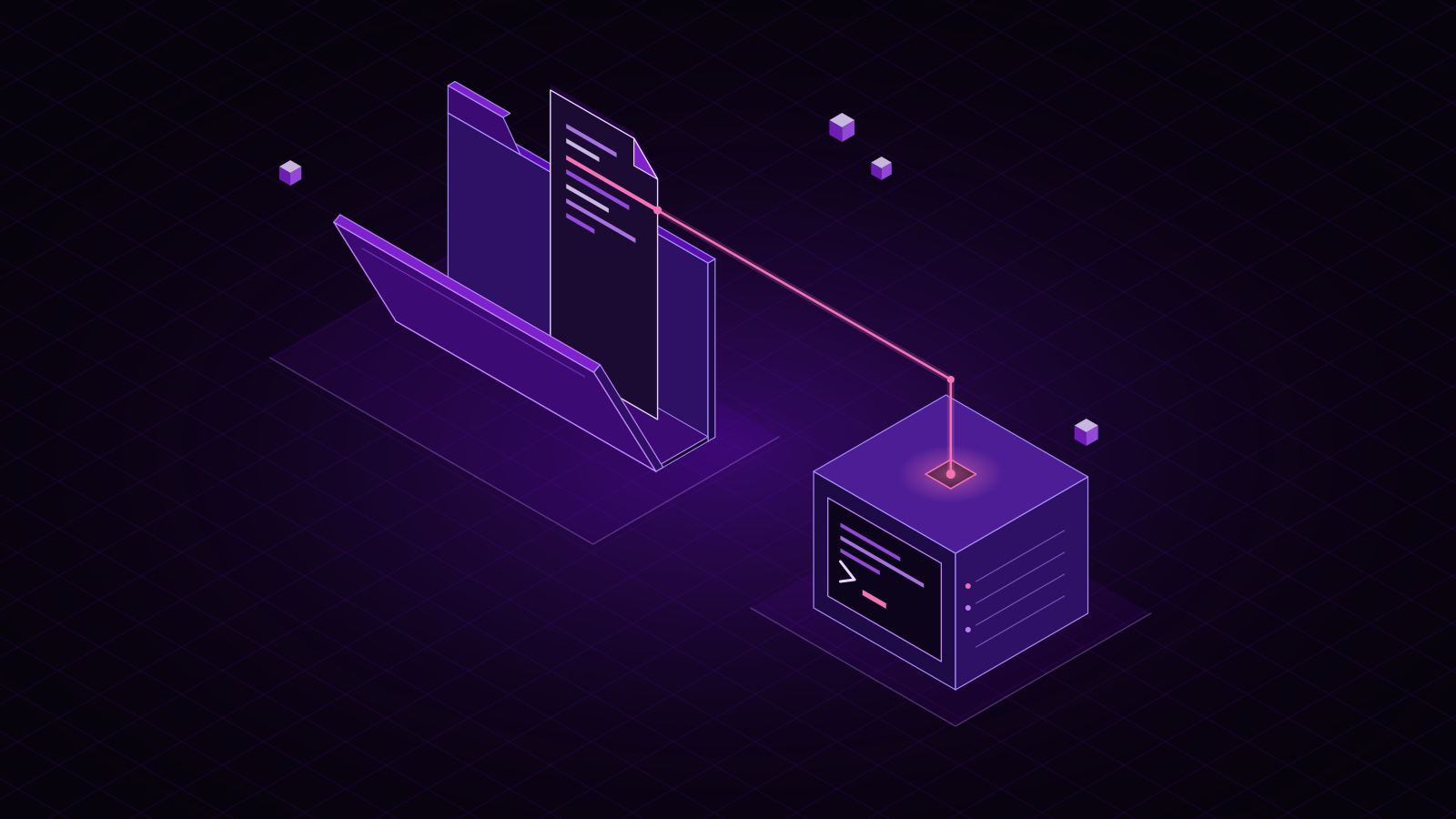
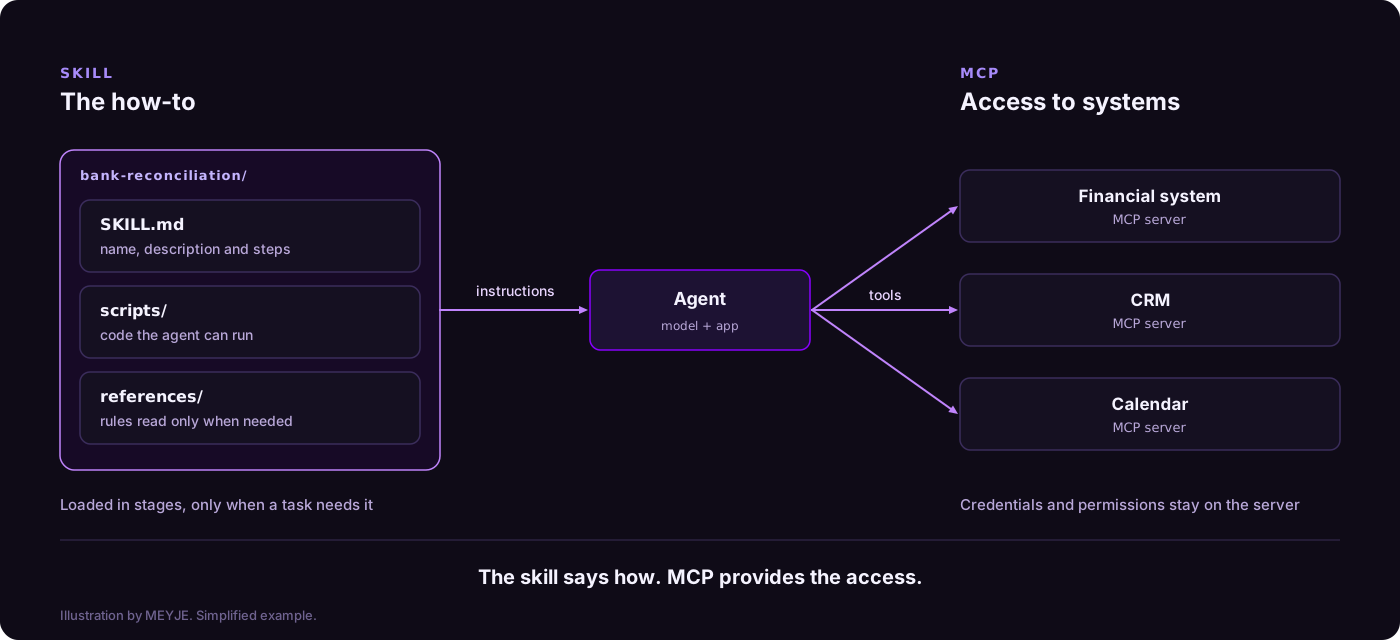
A skill is a folder that teaches an agent how to do a task. The only required file is SKILL.md: a YAML header with a name and a description, followed by instructions in Markdown. Next to it you can add scripts (scripts/), reference material (references/) and templates or data (assets/).
The trick is loading in stages. According to the specification, at startup the agent reads only the name and description of each skill, roughly 100 tokens. The body of SKILL.md enters the context when the skill is activated, and supporting files only when the task calls for them. So having many skills installed costs little context.
A short example:
---
name: bank-reconciliation
description: Matches the bank statement against the entries in the accounting system. Use when the user asks to check payments, find discrepancies or close the month.
---

# Bank reconciliation

1. Ask for the statement as a CSV file and the month to check.
2. Run `scripts/reconcile.py` with the statement and the month.
3. For each discrepancy, explain it in one line: date, amount and likely cause.
4. Never change entries. Propose the fix and wait for confirmation.

Categorization rules: see `references/categories.md`.
The name (lowercase letters, numbers and hyphens) must match the folder name. The description says what the skill does and when to use it: that is what the agent relies on to decide whether the skill fits the request.
#Skills and MCP: the "how" and the "access"
The two pieces solve different problems:
- MCP provides access. It is the protocol that connects the agent to external systems, such as a database, a CRM or a calendar, through servers that expose tools and data.
- A skill teaches the procedure. It says in what order to do things, which rules to follow, what to check before answering and which scripts to use.
In the example, an MCP server would provide access to the accounting entries, and the skill would say how to reconcile them. Access without a procedure leads to improvised answers; a procedure without access never gets off the page.
The two are already converging: MCP has an official extension (io.modelcontextprotocol/skills), whose proposal has reached final status, that lets MCP servers distribute skills in this format. That way, whoever maintains a service can publish usage instructions right next to it. Support in SDKs and apps is still being implemented.
#Why a neutral home matters
Anthropic launched skills in October 2025 and published the format as an open standard in December. Now it is handing the AAIF the standard, the name, the logo, the GitHub organization and the agentskills.io domain. The foundation operates under the Linux Foundation, was co-founded in 2025 by Anthropic, Block and OpenAI, and already hosted MCP.
According to Anthropic, more than 70 agent platforms have integrated the standard, including ChatGPT, Cursor, GitHub Copilot and VS Code. So far, 1 million skills have been published and nearly 280 million installed. Maintenance falls to engineers from Anthropic, Google, OpenAI and other companies, acting as individuals; the lead maintainers are David Soria Parra and Mahesh Murag. The proposed roadmap starts with versioned releases, a formal proposal process and security guidance for people who write and install skills.
For product teams, this matters for two reasons:
- Portability. With so many platforms reading the same format, a skill tends to work across agents from different vendors, and switching models doesn't mean rewriting your business knowledge.
- Less dependence on a single vendor. Changes to the format go through an open process, and you don't need to join the AAIF to use the standard or contribute to it.
#MCP now has a release calendar
The November 11 announcement replaces "when it's ready" releases with a calendar. Specification versions will ship every six months, generally on the last Tuesday of March and September. The next one is 2027-03-30, scheduled for March 30, 2027. Version names are still dates.
Each cycle has fixed milestones, counted back from release day:
| When | What happens |
|---|---|
| 2.5 months before | Soft freeze: proposals finalized; after that, only fixes and polish |
| 1.5 months before | Tier 1 SDKs publish beta versions |
| 1 month before | Hard freeze: critical fixes only |
| Release day | Specification and release notes published; Tier 1 SDKs stable |
According to the maintainers, there is nothing to change in existing clients and servers. What changes is how releases are prepared, not the messages or version negotiation.
The current version, 2026-07-28, made the protocol's core stateless: each request carries the protocol version and the client's capabilities, with no initialization step. More specialized features arrive as optional extensions. One example is the file extension, presented on November 10 as an experimental draft: it moves files between the client and tools without the content passing through the model, and the authors expect to stabilize it before the end of the year.
In practice, MCP becomes a dependency with release dates: you can put the upgrade on your roadmap and test the betas ahead of time.
#Skills are part of your supply chain too
Installing a third-party skill means putting someone else's instructions into your agent's context and, often, running someone else's scripts with its permissions. It is the same risk as installing a package from npm or PyPI, with one aggravating factor: a malicious instruction in Markdown doesn't look like code and slips easily through a rushed review.
MCP's Skills extension shows how the maintainers approach the problem. It requires hosts to treat skill content as untrusted input, demands explicit user approval before running code or granting permissions such as allowed-tools, and ties that approval to the exact set of files, each identified by its SHA-256 hash. If a file changes, the approval is revoked.
Until the Agent Skills security guidance is out, we recommend treating skills like any other dependency:
- Read before you install: the
SKILL.mdand every script, from start to finish. - Pin the version: point to a known commit and treat every update as a new install.
- Grant the minimum: be wary of skills that ask for broad tools, such as unrestricted terminal access.
- Isolate execution: skill scripts run without secrets, with restricted network access and a time limit.
- Keep an inventory: know which skills are installed in each agent and where they came from.
#What this changes for people building agents
At MEYJE we build AI agents for clients, and the maturing of these standards reinforces three practices in how we design them:
- Package knowledge as portable skills. Business rules and procedures become skills that are versioned and reviewed like code, instead of instructions locked into a single platform.
- Keep instructions separate from access. The skill says how; the MCP server provides access, with its own credentials and permissions. That way, switching models doesn't mean rewriting everything, and no secret ends up in the text the model reads.
- Review what you install. Third-party skills go through the same process as any dependency: reading, a pinned version and isolated execution.
And a fourth, simpler one: put MCP's release dates on your product calendar.
If you want an AI agent that follows your company's processes and works with the systems it already uses, talk to us.
Sources
- Donating Agent Skills to the Agentic AI Foundation (Anthropic, Oct 22, 2026)
- A More Predictable Release Cycle for MCP (MCP blog, Nov 11, 2026)
- Exploring File Uploads and Downloads in MCP (MCP blog, Nov 10, 2026)
- Agent Skills specification (agentskills.io)
- MCP Skills extension (official MCP site)
- Changes in the 2026-07-28 MCP specification (official MCP site)